
The Middle East contains some of the world’s most varied expatriate cost of living environments. Xpatulator’s data as at 1 July 2026 shows that the region cannot be assessed using a single average. Jerusalem, Abu Dhabi, Dubai, Kuwait City and Doha each have different cost structures, while Beirut, Sanaa, Baghdad, Damascus and Tehran present a different mix of cost, availability and operational risk.
Jerusalem is the highest ranked Middle East city in the Xpatulator data, with an index of 99.6. This places it close to the New York City benchmark. Housing, services, imported consumption and regional uncertainty all affect the expatriate basket.
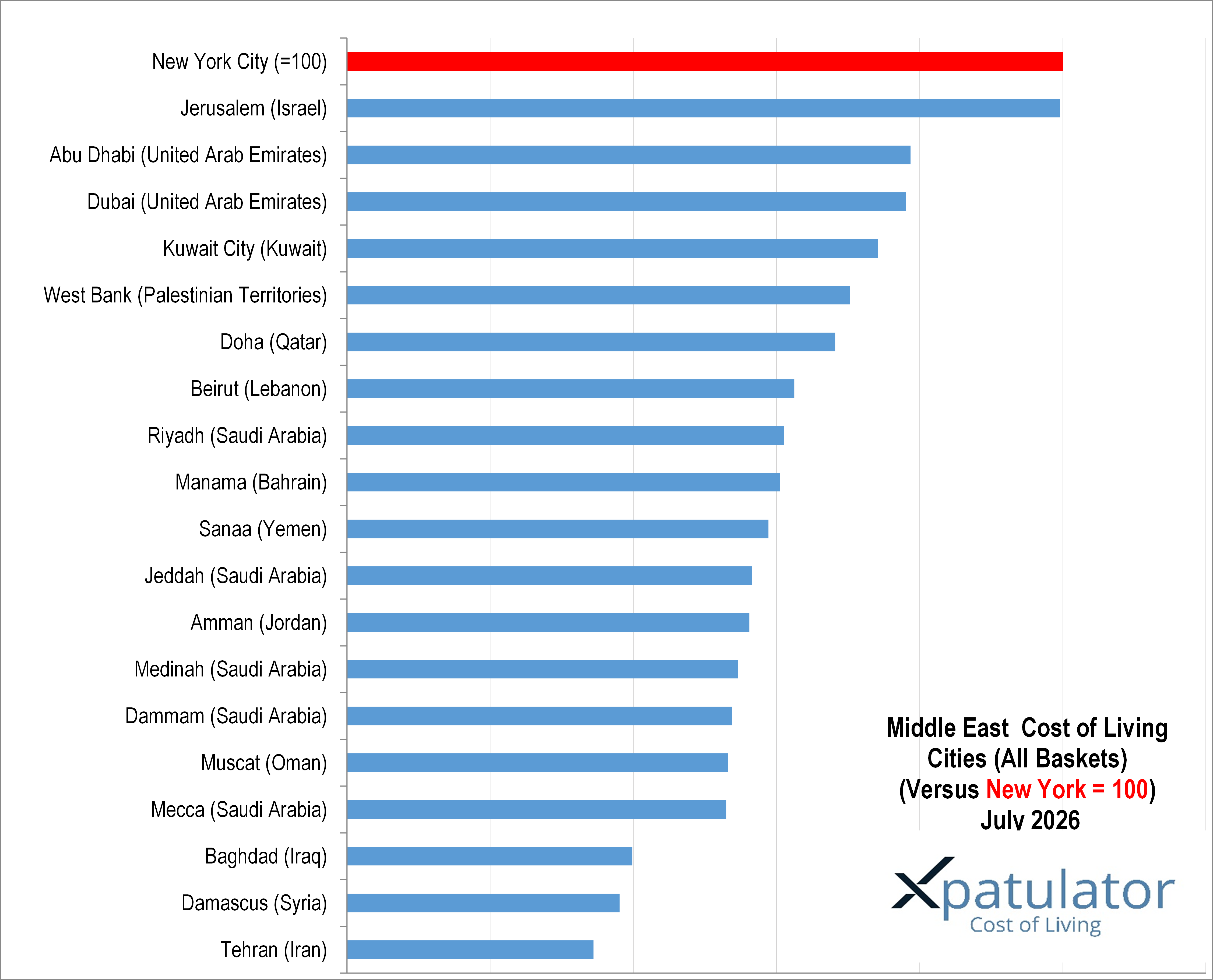
Abu Dhabi and Dubai remain high cost Gulf locations for expatriates. The main cost drivers are accommodation, international schools, private healthcare, transport, restaurants and imported goods. These costs can vary widely depending on neighbourhood, family size and lifestyle assumptions.
Kuwait City is also a material cost location, particularly for housing, imported goods and services. Doha sits lower in the ranking, but expatriate families can still face high costs where international schooling and larger accommodation are required.
Saudi Arabia’s main cities show more moderate cost levels in the Xpatulator ranking. Riyadh is higher than Jeddah, Medinah, Dammam and Mecca, reflecting its role as a major business centre. Housing compounds, private healthcare, transport and schooling remain important package considerations.
Manama, Muscat and Amman are moderate by regional comparison, but they can still be expensive for expatriates who require premium accommodation, imported groceries, private healthcare and international education.
Lower ranked locations such as Baghdad, Damascus and Tehran should not be judged by index values alone. In these environments, practical expatriate costs may be linked to secure accommodation, logistics, transport, contingency arrangements and access to reliable services.
Inflation and exchange rates remain important. Several Gulf currencies are fixed against the United States dollar, which reduces exchange rate volatility in dollar based comparisons. Other locations may face more complex currency and availability effects, especially where imported goods or hard currency access are constrained.
The main lesson for expatriates is clear. A salary offer should not be assessed only by its gross value. The relevant question is whether the salary protects purchasing power after local rent, utilities, groceries, healthcare, education, transport and personal services have been considered.
For employers, cost of living data supports fairer and more consistent assignment packages. It helps identify whether a cost of living allowance, housing support, schooling support or hardship related provision is needed.
Xpatulator’s Salary Purchasing Power Parity Calculator helps estimate the salary required to maintain living standards when moving between locations. The
Xpatulator’s Cost of Living Index report calculator produces index values for multiple host locations relative to a chosen home base of 100. It outlines why a global mobility specialist would use a multi location index report to support location comparisons, policy decisions and early stage budgeting, and it emphasises the practical importance of basket selection and cost allocations so the index reflects costs that employees actually pay from salary. It concludes with a clear step by step guide to running and saving the report.
Use Xpatulator’s Cost of Living Calculators and Tools to compare Middle East locations and make informed decisions on salary, allowances and assignment packages.


 Expatriate International Cost of Living