
The latest Xpatulator ranking of the world’s most expensive cities shows that the highest cost locations are shaped by a combination of housing, services, currency movements, imported goods and local market constraints. For expatriates and international assignees, these factors can make a major difference to salary purchasing power.
The ranking uses New York City as the base location, with an index of 100. The current top twenty city locations are Monaco, Hong Kong, China, Zurich, Singapore, Manhattan, San Jose, San Francisco, Geneva, Oslo, Sydney, London, Copenhagen, Wellington, New York City, Boston, Jerusalem, Honolulu, Seattle, Auckland and Shanghai.
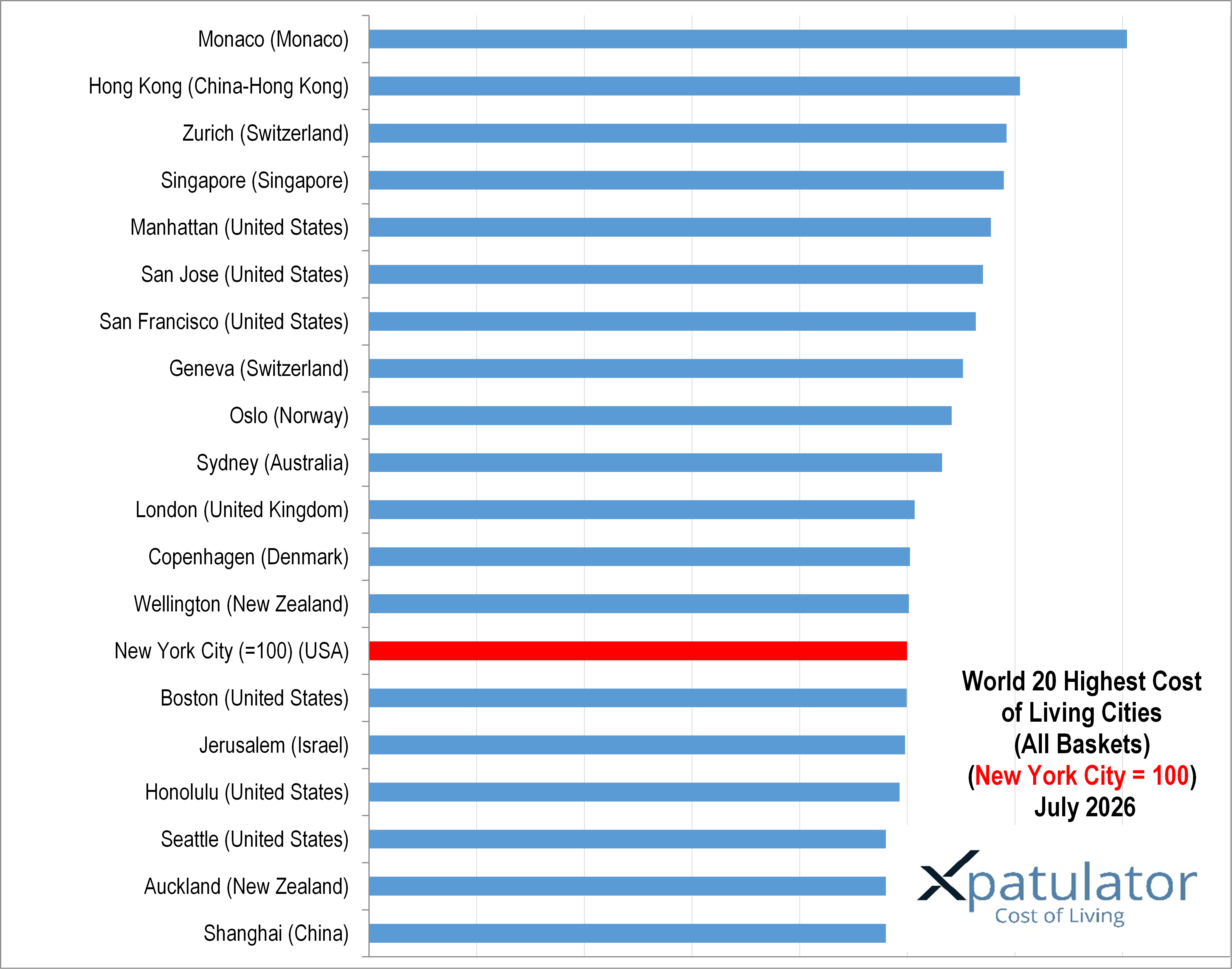
Monaco is the most expensive location in the ranking, with an index of 140.8. The main reason is accommodation. Limited land and strong demand from high income international residents keep property and rental costs high. Imported goods, premium services and restaurant costs add further pressure.
Hong Kong, China remains highly expensive because expatriate accommodation is costly and land is limited. Singapore is also a high cost city because of housing, education, transport, groceries and services. Both cities are major international business centres, which increases demand for expatriate grade housing and services.
Zurich and Geneva reflect Switzerland’s high wage, high service cost economy. Expatriates moving to Switzerland should pay close attention to healthcare, housing, restaurants, transport and the exchange rate between the Swiss franc and their home currency.
In the United States, Manhattan, San Jose, San Francisco, Boston and Seattle remain high cost locations. Housing is the main driver, supported by strong labour markets and high service costs. Honolulu is different because distance and shipping costs have a greater effect on groceries and household goods.
Sydney, Wellington and Auckland are examples of attractive but expensive locations where distance, housing and imported goods can raise the cost of living. London, Oslo and Copenhagen are high cost European locations where housing, transport and services can materially affect the expatriate budget.
Jerusalem illustrates how regional uncertainty can influence living costs indirectly through insurance, security and travel patterns. Shanghai remains below the New York City benchmark in this ranking, but expatriate costs can increase quickly where international schooling, premium accommodation and private healthcare are required.
The main lesson is that salary should not be compared in isolation. A higher salary in another country may still reduce disposable income if housing, healthcare, education, transport and everyday services are more expensive. Exchange rates and inflation can also change the position during an assignment.
For expatriates, a cost of living comparison helps assess whether an offer will maintain the current standard of living. For employers, it helps design salary and allowance packages that are fair, consistent and defensible.
Xpatulator’s Salary Purchasing Power Parity Calculator helps compare home and host locations and estimate the salary required to preserve purchasing power.
Use Xpatulator’s Cost of Living Calculators and Tools to support better decisions on relocation, salary purchasing power and international assignment packages. For more, read our FAQ‘s.


