
The latest Xpatulator country and state cost of living ranking shows how sharply expatriate living costs can vary across countries, states and combined city country state locations. The ranking is based on the cost of living for international professionals and managers, using New York City as the base location with an index of 100.
For this ranking, the relevant comparison includes country and state locations as well as combined city country state locations. City-only locations are excluded. This makes the ranking useful for expatriates, international assignees and global mobility teams who need to compare broader country or state level cost differences before structuring a salary package or relocation allowance.
Monaco ranks as the most expensive country and state location in the latest Xpatulator ranking, with a weighted cost of living index of 140.8 and a global rank of 1 out of 780 locations. Hong Kong, China ranks second with an index of 120.9. Singapore ranks fourth globally with an index of 117.9.
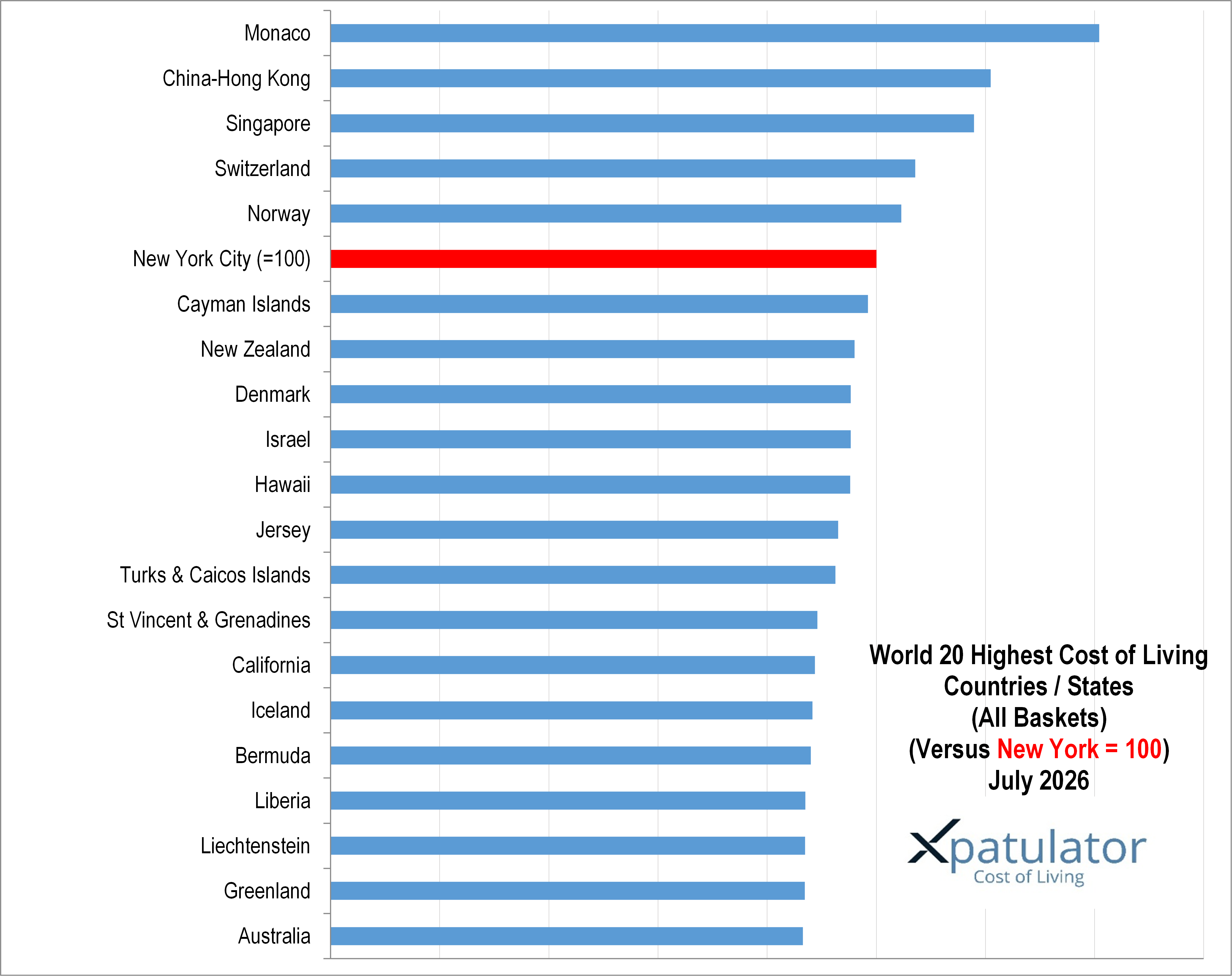
Switzerland follows with an index of 107.1, while Norway records 104.6. The Cayman Islands rank next among the highest cost locations, with an index of 98.5. New Zealand, Denmark, Israel, Hawaii in the United States, Jersey, the Turks and Caicos Islands, Saint Vincent and the Grenadines, California in the United States, Iceland, Bermuda, Liberia, Liechtenstein, Greenland and Australia also sit in the upper section of the ranking.
The high ranking of Monaco is mainly driven by limited land, high property prices, strong demand from internationally mobile residents, premium services and high prices for imported goods. For expatriates, accommodation is often the defining cost. A salary package that may support a comfortable standard of living in many European locations may not provide equivalent purchasing power in Monaco unless housing is considered separately.
Hong Kong, China remains expensive because of land scarcity, high density, accommodation costs and the price of imported goods and services. While parts of the local economy are efficient and competitive, expatriate housing and international schooling can place substantial pressure on household budgets. This makes Hong Kong, China a location where a detailed cost of living comparison is particularly important.
Singapore’s ranking reflects its position as a major international business hub. It combines a high income economy, significant demand for expatriate grade housing, import dependence and high standards of services. Housing, education, transport, groceries and restaurants can all be material cost items for expatriates. The city state remains highly efficient, but that does not remove the cost impact of land scarcity and labour costs.
Switzerland and Norway continue to rank highly because they are high wage, high service cost economies. Restaurants, personal care, transport, professional services, insurance and household services tend to be expensive. Switzerland is also influenced by the strength of the Swiss franc, which can affect employees paid in other currencies. Norway’s cost profile reflects high wages, taxation, transport costs and the general price level.
Several small island economies rank highly because they depend heavily on imports and have limited domestic supply. The Cayman Islands, Jersey, the Turks and Caicos Islands, Bermuda, the Bahamas, Montserrat, the United States Virgin Islands, Grenada, Saint Kitts and Nevis, Antigua and Barbuda, the British Virgin Islands and Barbados are affected by shipping, insurance, customs costs, limited housing supply and smaller retail markets. These factors can raise the price of groceries, household goods, private healthcare, motor vehicles and suitable accommodation.
Remote locations also show the cost impact of distance. New Zealand, Iceland, Greenland, Hawaii and Alaska face longer supply chains and smaller domestic markets. Imported food, furniture, appliances, vehicles and construction materials can be more expensive because of transport and logistics costs. In some of these locations, housing supply is also constrained by geography, planning limitations or strong demand in desirable areas.
Israel’s ranking is influenced by high housing and service costs, with additional pressure from regional uncertainty. Security related costs, insurance, travel disruption and supply chain risk can all affect expatriate living costs. Liberia and Gabon show a different pattern. They demonstrate that expatriate costs can be high in lower income economies where secure accommodation, reliable utilities, private transport, imported goods, private healthcare and international education are required.
The United States state entries reinforce the importance of looking below national averages. Hawaii is affected by shipping and local supply constraints. California reflects high housing costs, strong demand from higher income sectors, taxation and service prices. Massachusetts is shaped by housing, healthcare, education and professional services. Alaska reflects distance, logistics and climate related supply issues. A national United States cost comparison may therefore be too general for an assignee moving to a specific state.
Inflation and currency movements remain important in any international comparison. A location may become more expensive because local prices rise, because the host currency strengthens, or because the employee’s home salary currency weakens. The opposite can also occur. This is why salary purchasing power should be reviewed using current cost of living data and current exchange rates, rather than relying only on historic salary comparisons.
For expatriates, the key issue is not the headline salary but the standard of living that salary can support. Rent, utilities, groceries, healthcare, school fees, transport, recreation, personal care and household goods can absorb very different shares of income depending on the host location. A move to Monaco, Hong Kong, China, Singapore, Switzerland, Norway or the Cayman Islands may require a higher salary, a housing allowance, an education allowance or a wider assignment package to maintain a comparable lifestyle.
For employers, cost of living data supports more consistent and defensible mobility decisions. It helps determine whether an offer is competitive, whether an allowance is justified, and whether the assignee is likely to maintain purchasing power after relocation. It can also reduce the risk of assignment dissatisfaction, retention issues and post arrival package renegotiation.
Xpatulator’s Salary Purchasing Power Parity Calculator helps estimate the salary required to maintain purchasing power between home and host locations. It is particularly useful where the two locations have different currencies, inflation trends and expatriate cost structures.
Use Xpatulator’s Cost of Living Calculators and Tools to compare international locations and make informed decisions on the salary, allowance and assignment package required to maintain a comparable standard of living.


