
International cost of living rankings often combine very different types of economies. Xpatulator’s data as at 1 October 2026 illustrates this clearly.
Monaco ranks 1st with a Cost of Living Index of 139.8. Hong Kong, China ranks 2nd at 119.5 and Singapore 3rd at 116.7. These locations share one important characteristic: limited space combined with strong international demand.
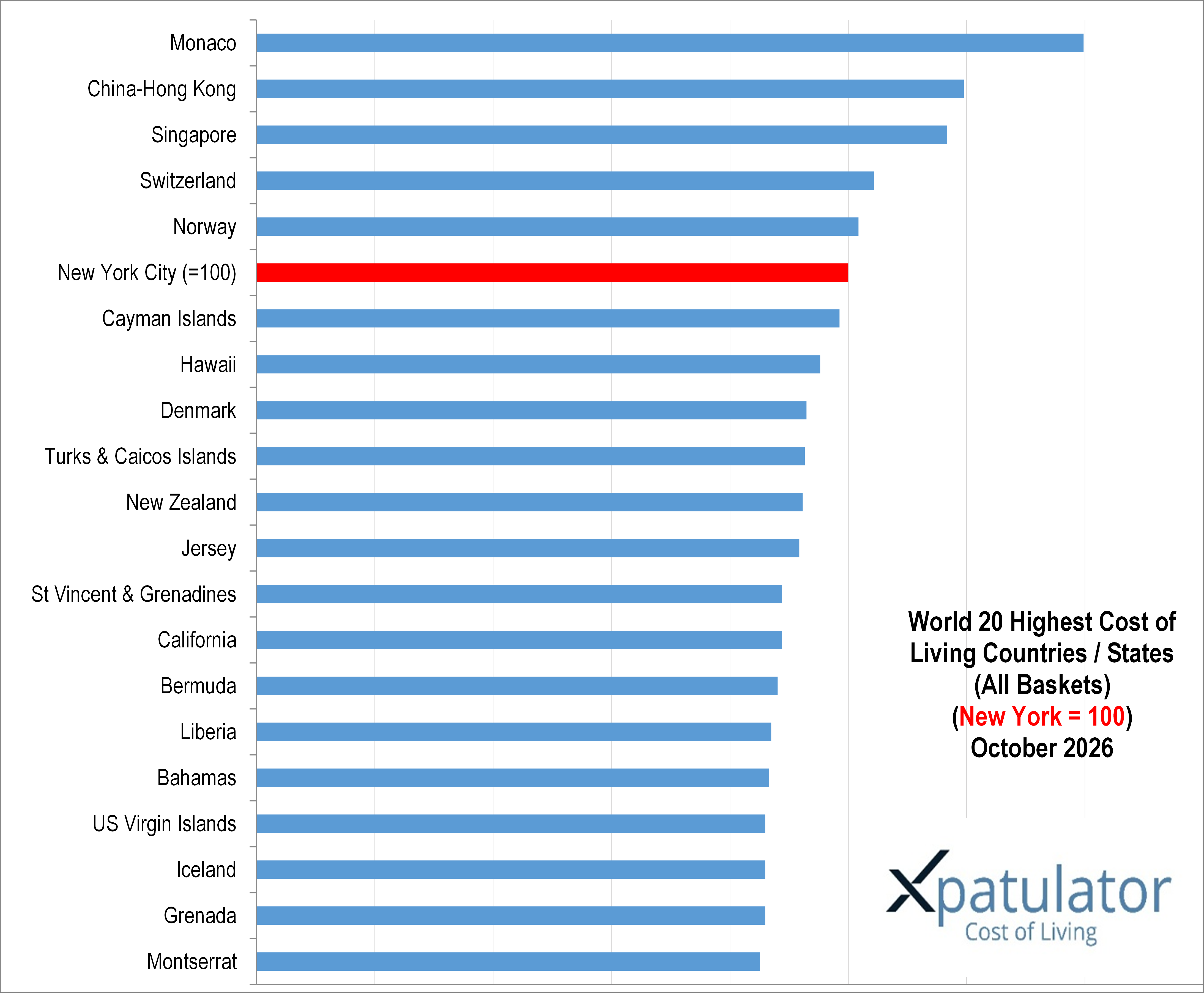
Monaco’s constraint is particularly severe. Housing supply cannot expand easily, while demand comes from a wealthy international population. Hong Kong faces similar land constraints on a much larger scale, with accommodation accounting for a substantial part of the cost of maintaining an international professional lifestyle. Singapore also faces limited land, but its cost structure extends beyond housing into private transport, clothing, personal care and education.
Switzerland and Norway rank 4th and 5th for a different reason. Both have high wages and expensive domestic services. Transport and personal services therefore cost considerably more than in many other countries even where accommodation itself is not the dominant source of the premium.
Island locations create a third model. The Cayman Islands ranks 6th, Hawaii 7th and the Turks and Caicos Islands 9th. These economies face freight costs, dependence on imported goods and smaller retail markets. The result can be high grocery, communication and transport costs even when housing is less expensive than in Monaco or Hong Kong.
Exchange rates add another dimension. Hong Kong’s currency is linked to the United States dollar, so its international cost is relatively insulated from foreign exchange swings.
New Zealand, by contrast, has a floating currency. Its dollar weakened over the year to the end of September 2026, helping its ranking decline 3 places to 10th when costs are measured internationally.
Inflation adds further complexity. Singapore consumer inflation was 2.3 per cent in August, while import prices rose much faster because of higher energy costs. Xpatulator’s October international inflation analysis also points to renewed global energy and freight pressures associated with Middle East instability.
This explains why a cost of living ranking should not be treated as a simple inflation table. A location can move because its currency changes, because another location moves more quickly, or because the prices of heavily weighted expenditure categories change.
For an expatriate, the relevant question is therefore not whether the proposed overseas salary is numerically higher. The question is whether it buys at least the same standard of living after rent, transport, groceries, healthcare, education and other unavoidable costs have been paid. Xpatulator’s Salary Purchasing Power Parity Calculator provides a structured way to make that comparison.


