
Africa’s highest expatriate cost cities demonstrate why local income levels are a poor guide to the cost of an international assignment.
Xpatulator’s data as at 1 October 2026 places Monrovia 1st in Africa with a Cost of Living Index of 94.8. Libreville ranks 2nd, Abidjan 3rd, Lagos 4th and Abuja 5th. New York City is set at 100, meaning Monrovia’s expatriate basket is only moderately below the New York benchmark despite the very different income levels of the two economies.
The explanation lies in what an internationally mobile household buys. Expatriates often require secure accommodation, reliable utilities, private transport, healthcare, international education and imported groceries. These goods and services can exist within relatively small premium markets and may have little relationship to the prices paid by most local households.
Monrovia illustrates the point. Its transport basket is substantially above New York City, while international education and groceries are also relatively expensive. Liberia imports many goods and has limited foreign exchange buffers, although its currency has remained comparatively stable during 2026.
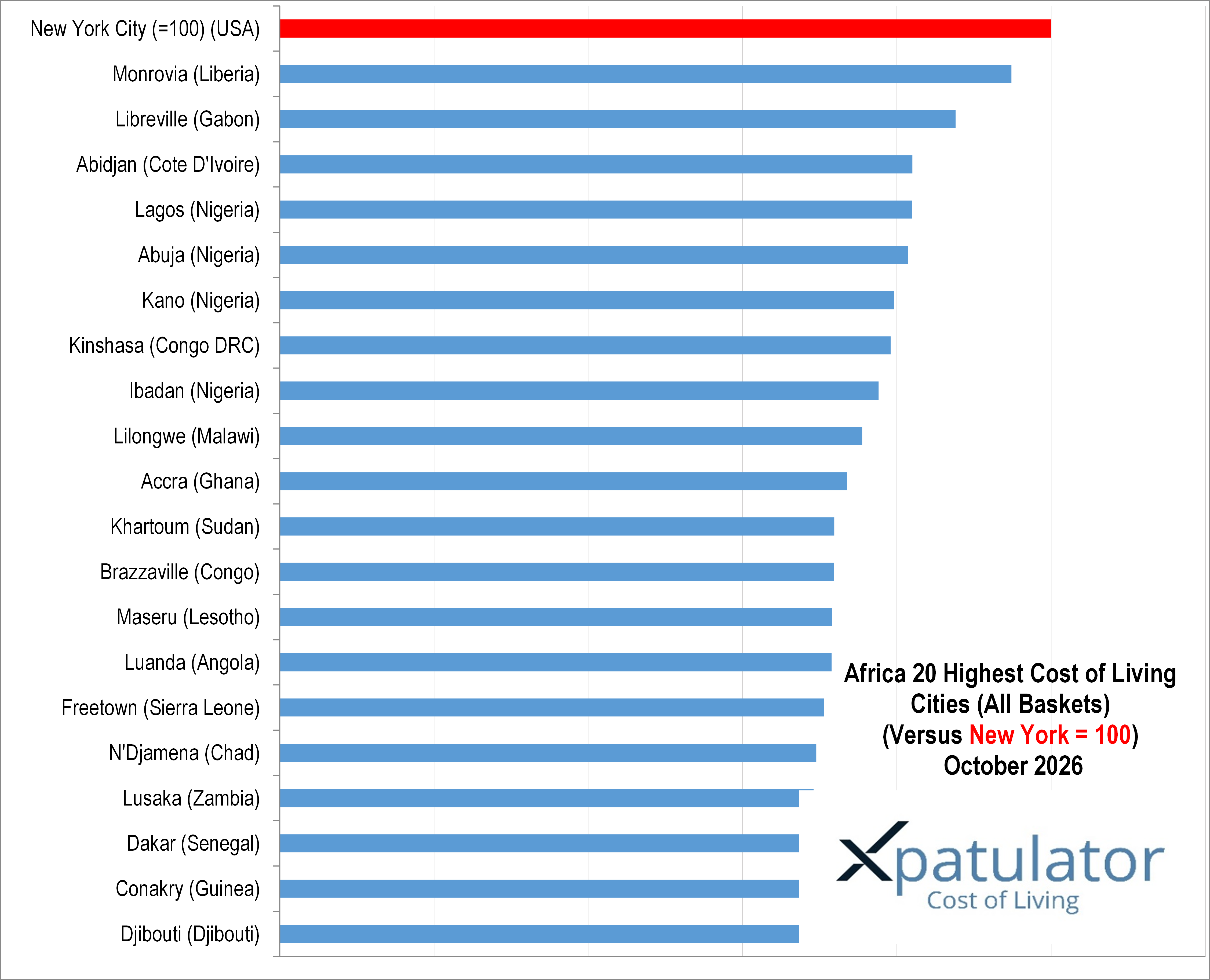
Libreville and Abidjan demonstrate a different combination. Communication and groceries are expensive in both, while Abidjan also has relatively high education and transport costs. Their currencies are linked to the euro, which weakened by about 3 per cent against the United States dollar over the year to the end of September. This helps reduce their dollar converted costs, but does not eliminate the structural premiums associated with imported consumption and specialist services.
Nigeria presents another model. Lagos, Abuja, Kano and Ibadan all rank within Africa’s top eight. Private power, healthcare, transport and services contribute to the expatriate cost base. The naira has also strengthened against the United States dollar compared with a year earlier. At the same time, September brought another sharp increase in petrol and diesel prices, which affects almost every business and household through transport and electricity generation.
Inflation adds a further complication. Malawi’s inflation remained 20.0 per cent in August and Lilongwe’s ranking rises 4 places to 9th. Angola, by contrast, saw inflation decline to 8.78 per cent while Luanda’s ranking rises 10 places to 14th. These apparently contradictory movements are possible because national inflation measures price changes over time within one economy, while an international Cost of Living Index compares the cost of a particular basket across locations and exchange rates.
Conflict can make the distinction even greater. Khartoum remains 11th, but Sudan’s currency has depreciated severely and its economy remains fragmented by war. Some ordinary local prices may appear low when converted into foreign currency, while the cost of secure accommodation, healthcare, transport and reliable utilities required by an international organisation can remain substantial.
This is why an overseas salary should not be judged simply by converting it at the prevailing exchange rate. A better comparison asks what the employee currently buys at home and how much income is required to purchase an equivalent basket in the destination. Xpatulator’s methodology applies weighted expatriate expenditure baskets to that comparison, while its Salary Purchasing Power Parity Calculator estimates an equivalent host salary designed to maintain the same standard of living.


