
America’s most expensive expatriate locations include some of the world’s largest metropolitan economies, but the top rankings also contain a notable group of small island cities.
Xpatulator’s data as at 1 October 2026 places Manhattan 1st, San Jose 2nd and San Francisco 3rd. Yet George Town in the Cayman Islands ranks 8th, Hamilton in Bermuda 10th, Saint George’s in Grenada 11th and Kingstown in Saint Vincent and the Grenadines 12th. Nassau, Saint John’s and Basseterre also appear in the top 20.
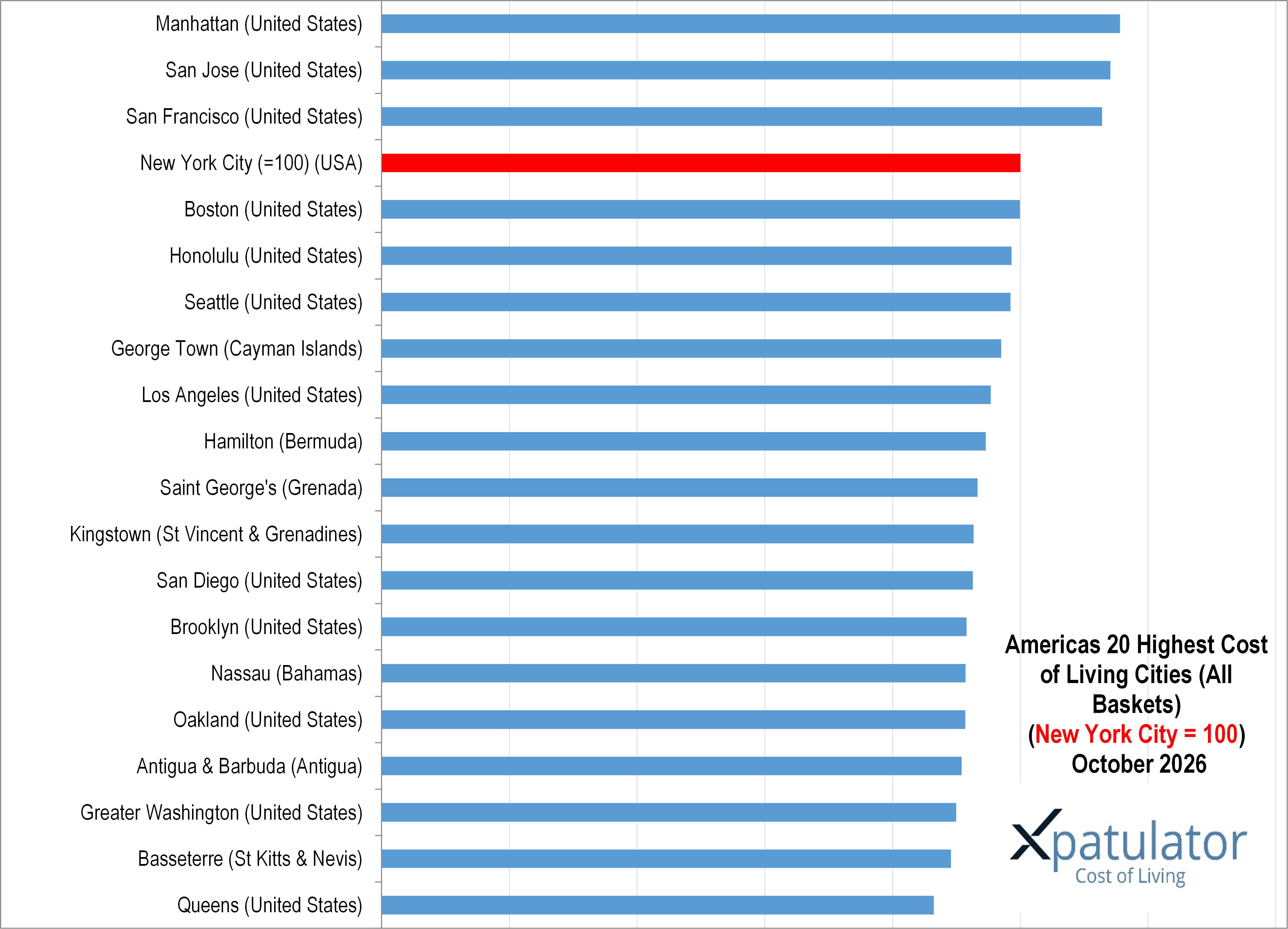
The reasons are different from those in Manhattan or Silicon Valley. In the United States technology and financial centres, high incomes compete for constrained housing while healthcare, transport and labour intensive services are costly. Manhattan rents reached record levels during 2026, while San Jose rents were almost 10 per cent higher in August than a year earlier.
Island economies face a different constraint. A large proportion of food, vehicles, furniture, appliances and consumer products must be transported from elsewhere. Freight, insurance, storage and distribution become part of the retail price. Smaller populations also mean fewer suppliers over which to spread fixed operating costs.
The Xpatulator data reflects this clearly. Communication and transport are particularly expensive in George Town. Hamilton combines high communication and grocery costs. Transport dominates much of the expenditure premium in Saint George’s and Kingstown, while Nassau records high communication and grocery costs.
Domestic inflation can reinforce these structural pressures. Cayman Islands consumer prices increased 2.8 per cent in the first quarter of 2026, while Bermuda recorded annual inflation of 2.5 per cent in April. Bahamian inflation was 2.7 per cent in February.
Currency risk is comparatively limited. Bermuda and the Bahamas maintain one to one parity with the United States dollar, the Cayman Islands dollar is fixed against it, and the Eastern Caribbean dollar has remained fixed at 2.70 to one United States dollar for 50 years. A United States dollar paid expatriate is therefore largely protected from exchange rate volatility in these locations. The trade off is that there is little currency depreciation available to offset rising local prices.
Weather and insurance are another consideration. Hurricane exposure can raise property insurance and resilience costs and can temporarily interrupt shipping and energy supply. The arrival of Hurricane Isaias in early October 2026, which disrupted Gulf of Mexico oil and gas production, illustrates how severe weather can also influence energy and logistics costs across a wider region.
For an expatriate, the implication is that an island assignment should not be assumed to be inexpensive because the local population or economy is small. The relevant comparison is the price of the particular goods and services that the employee and family will need.
Xpatulator’s Salary Purchasing Power Parity Calculator compares those costs with the employee’s home location and estimates the host salary required to maintain a comparable standard of living. That provides a stronger basis for evaluating an overseas offer than comparing nominal salaries or exchange rates alone.


