
A city’s cost of living ranking can fall even while its residents face higher inflation. Xpatulator’s Asia Pacific data as at 1 October 2026 provides several examples.
Sydney remains 3rd in the region, but its Cost of Living Index declines from 106.4 in July to 102.5. Canberra, Perth, Melbourne, Brisbane and Adelaide also record lower indexes. Yet Australian consumer inflation accelerated to 4.0 per cent in August, with housing up 5.7 per cent over the year.
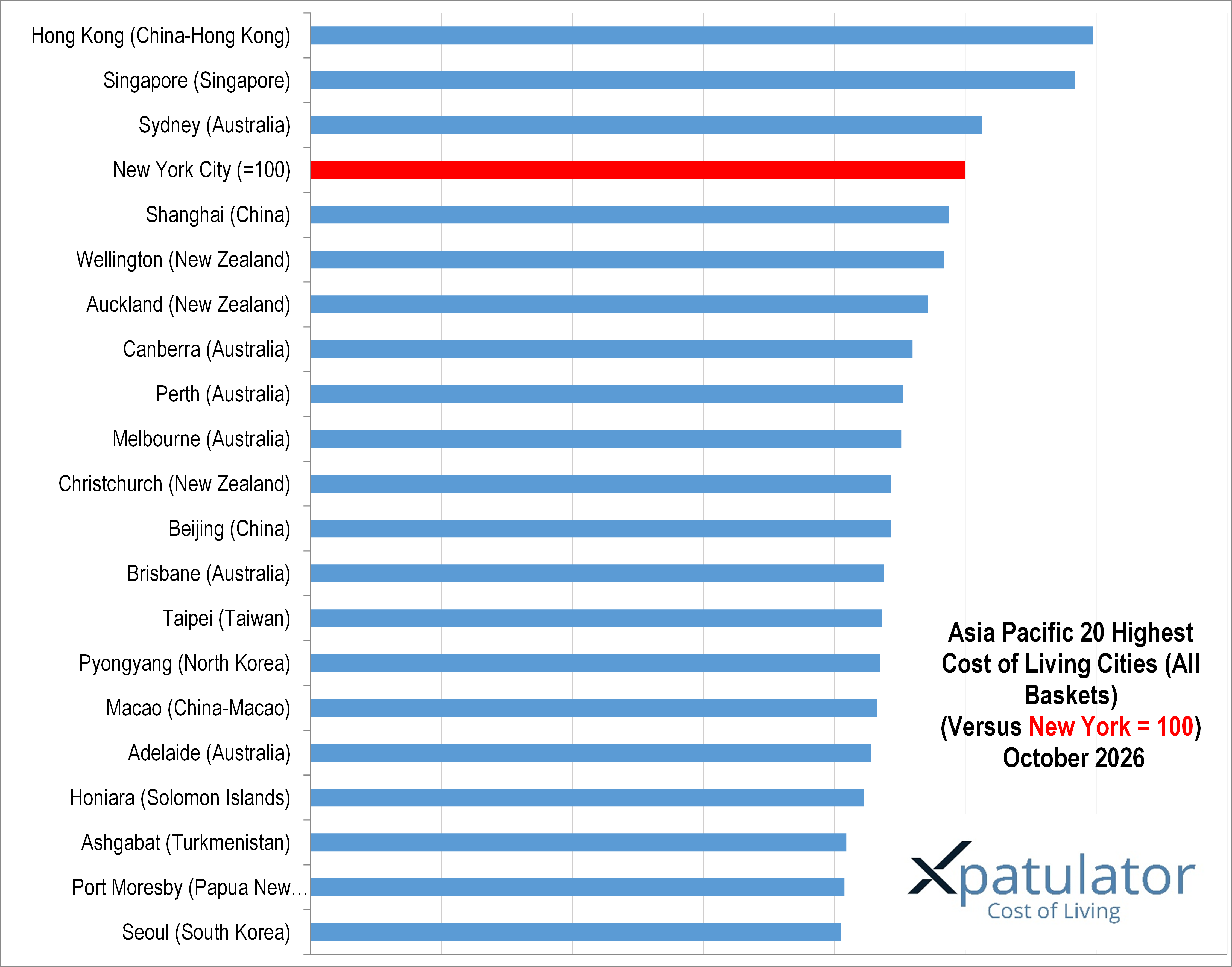
New Zealand is similar. Wellington’s index falls from 100.3 to 96.7 and Auckland from 97.9 to 94.3. New Zealand consumer inflation, however, reached 4.1 per cent in June, its highest level since early 2024, with fuel and electricity important contributors.
The difference comes partly from exchange rates. International cost comparisons need to translate prices between currencies. The New Zealand dollar bought 0.57825 United States dollars on 30 September 2025 but only 0.56405 a year later. For someone paid in United States dollars, the same amount of New Zealand dollar spending therefore became cheaper in dollar terms. For a locally paid household, the weaker currency can instead raise import prices.
China shows the reverse mechanism. The yuan strengthened during 2026 and reached its strongest level in more than three years against the United States dollar in September. Shanghai rises 2 places to 4th and Beijing rises 2 places to 11th, although subdued domestic demand continues to restrain general consumer price pressure. A stronger currency can increase international costs even when local inflation is relatively modest.
Hong Kong, China and Singapore are different again. Hong Kong’s currency is linked closely to the United States dollar, so foreign exchange contributes relatively little to ranking changes. Accommodation remains the dominant cost, and renewed recruitment in finance and professional services is supporting demand for internationally suitable housing. Singapore manages its currency against a basket of trading partners and is considering tighter monetary settings as inflation risks rise.
Smaller locations highlight the role of logistics. Honiara faces higher inflation partly because of imported energy costs. Port Moresby remains affected by foreign exchange availability, imported goods and the cost of suitable accommodation and transport. Ashgabat operates with a more restricted market and dual exchange rates, making international price comparison less straightforward.
Geopolitical developments add another layer. Oil remains above 100 United States dollars per barrel amid Middle East instability, while global food prices reached their highest level in almost four years in September. Import dependent Asia Pacific economies are particularly exposed because higher energy and freight costs feed into groceries, utilities and transport.
This is why inflation alone is not sufficient when assessing an international salary. An expatriate needs to compare the actual cost of the goods and services funded from salary in the home and host locations, together with exchange rates and major fixed costs such as accommodation and education.
Xpatulator’s Salary Purchasing Power Parity Calculator provides that comparison by estimating the host salary required to preserve purchasing power. It offers a more meaningful measure of an international job offer than comparing nominal salaries or applying a general inflation adjustment alone.


