
Europe contains some of the world’s most expensive expatriate locations. Xpatulator’s data as at 1 July 2026 shows Monaco, Zurich, Geneva, Oslo, London and Copenhagen all above the New York City benchmark.
The ranking uses New York City as the base location, with an index of 100. Monaco ranks first in Europe and globally at 140.8. Zurich ranks second in Europe at 118.4, followed by Geneva at 110.3, Oslo at 108.2, London at 101.4 and Copenhagen at 100.5.
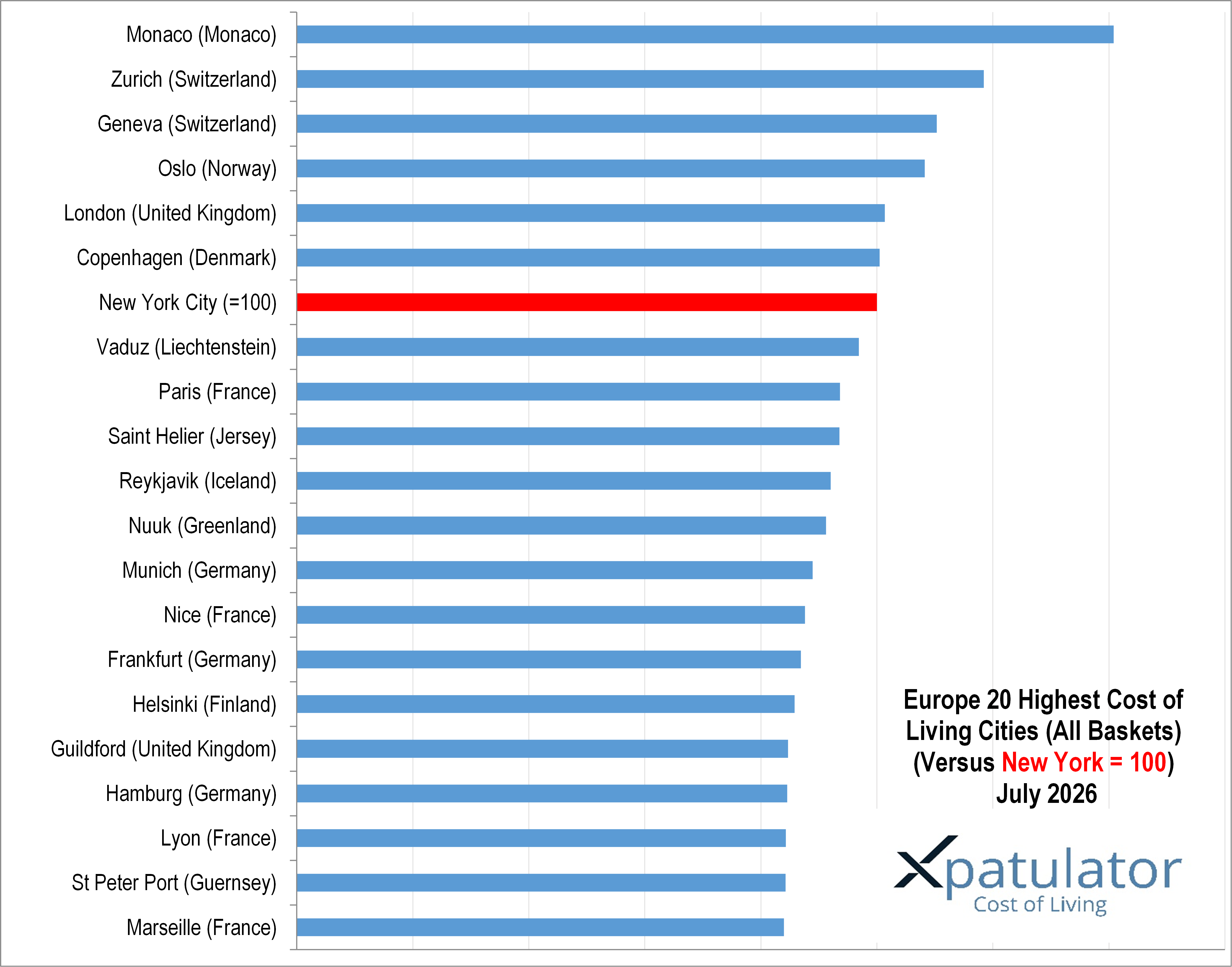
These cities are expensive for different reasons. Monaco is shaped by scarce land, high property values and strong international demand. Zurich and Geneva reflect high wages, high service costs, expensive healthcare and the Swiss franc. Oslo and Copenhagen reflect the cost structure of Nordic high income economies, where services, transport, childcare and restaurants can be expensive.
London remains above the New York City benchmark because of housing, private rents, transport, childcare and the cost of paid services. United Kingdom national averages are not enough for London assignments because neighbourhood, commute and school choice can change the budget significantly.
Paris, Nice, Lyon and Marseille show that costs in France differ materially by city. Paris remains expensive because of housing and central services, while Nice and Marseille reflect Mediterranean demand and lifestyle related costs. Munich, Frankfurt, Hamburg and Berlin show similar city level variation in Germany.
Vaduz, Saint Helier and St Peter Port are smaller markets where limited housing supply and imported goods can create high expatriate costs. Reykjavik and Nuuk show the cost of distance, freight, limited retail competition and small housing markets.
Inflation and exchange rates remain important. A stronger euro, Swiss franc, pound sterling or Nordic currency against the United States dollar can raise the converted cost of living. Energy related inflation can also affect utilities, transport and logistics, which then influence the expatriate basket.
The main lesson for expatriates is that salary offers should not be assessed using gross salary alone. Rent, healthcare, education, transport, utilities, groceries and personal services can absorb very different shares of income depending on the host city.
For employers, cost of living data supports fairer and more consistent assignment packages. It helps identify whether housing support, schooling support, transport support or a cost of living allowance is needed.
Xpatulator’s Salary Purchasing Power Parity Calculator helps compare home and host locations and estimate the salary required to maintain a comparable standard of living.
Use Xpatulator’s Cost of Living Calculators and Tools to support better decisions on European relocation, salary purchasing power and international assignment packages.


